The Rise of Indie Games: Why Independent Studios Are Winning in 2026
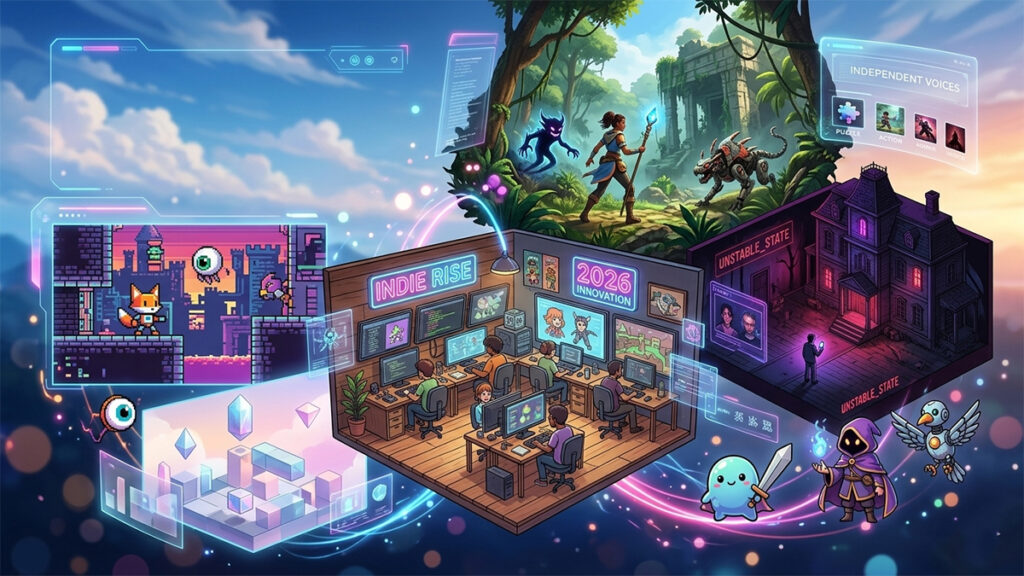
The gaming landscape has hit a definitive tipping point. For decades, “AAA” was the undisputed gold standard for quality and success. But as we move through 2026, the narrative has shifted. While major publishers struggle with $70 price tags, bloated development cycles, and “safe” sequels, independent (indie) games have moved from the fringe to the absolute center of the industry.
In 2025, the three best-selling new games on Steam by unit volume weren’t blockbusters from EA or Ubisoft—they were indie titles like R.E.P.O. and PEAK, developed by small teams and priced under $20. This isn’t just a trend; it is a structural revolution.
Indie Games Are Dominating the Gaming Market
In 2026, the power has shifted. Indie games now command 52% of Steam’s total revenue, officially outperforming AAA blockbusters for the first time in history.
📈 Key Indicators
- The Growth: Indie revenue is surging at a 14.3% CAGR (Compound Annual Growth Rate), triple the rate of the traditional console market (4%).
- The Price Gap: Players are choosing $15–$30 “innovation-first” titles over bloated $70 sequels.
- Market Share: 95% of all new digital releases in 2026 are independent.
⚠️ Strategic Risks
- Discovery Fatigue: With thousands of new launches, the biggest challenge isn’t making a good game—it’s being found.
- AAA Retreat: Major publishers are doubling down on “safe” live-service models, leaving the door wide open for indie creativity.
What Is an Indie Game?
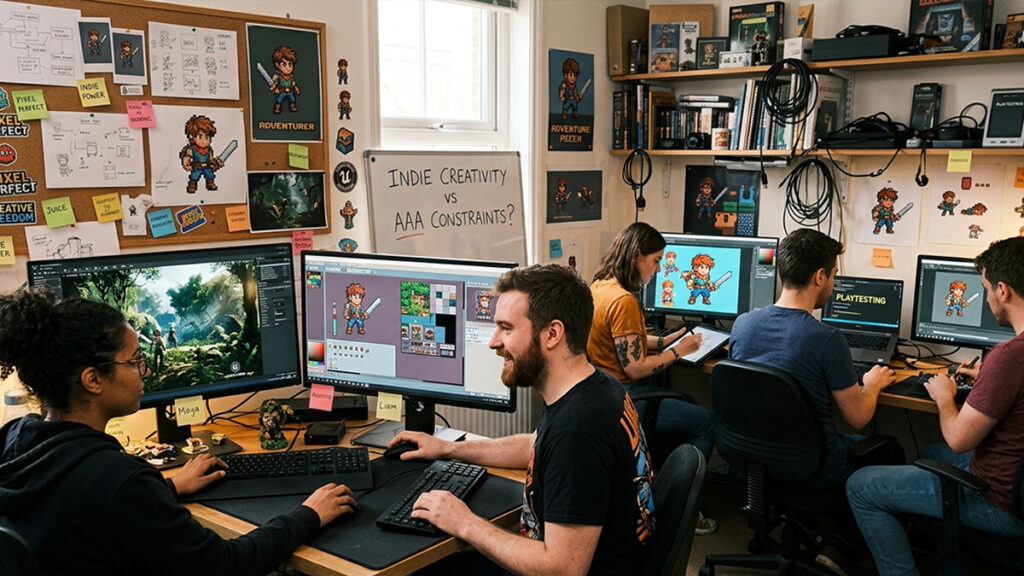
An indie game is typically developed by an individual or a small team without the financial backing or creative oversight of a major publisher.
Historically, “indie” implied a lower budget or pixel-art aesthetic. Today, the definition has expanded. “Triple-I” indies (like Supergiant Games or Pocketpair) now produce titles with high-fidelity visuals and deep mechanical complexity, but they retain the creative independence that allows them to take the risks that AAA studios avoid.
The Three Phases of the Indie Game Revolution
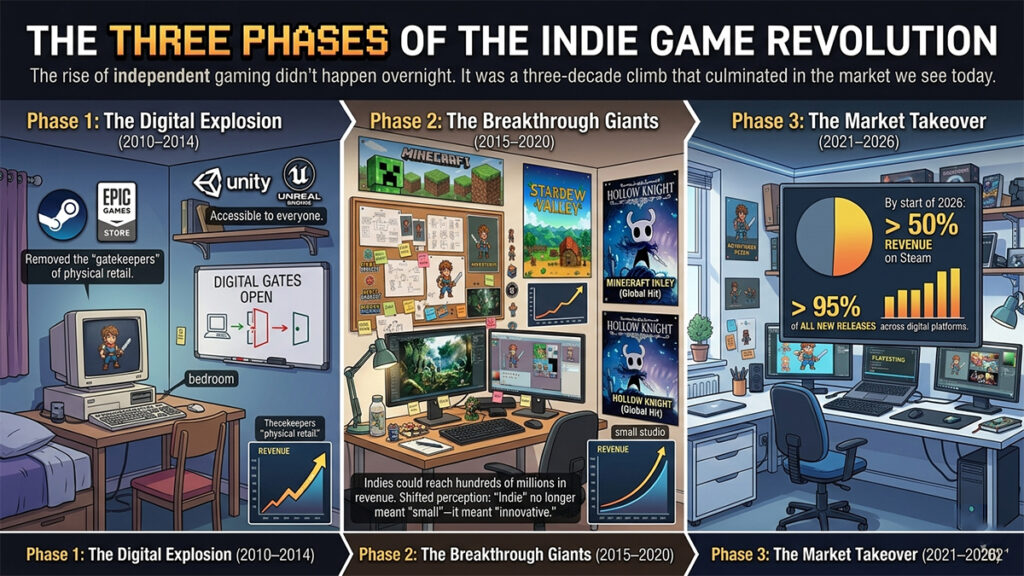
The rise of independent gaming didn’t happen overnight. It was a three-decade climb that culminated in the market we see today.
Phase 1: The Digital Explosion (2010–2014)
The launch of Steam, followed by the Epic Games Store, removed the “gatekeepers” of physical retail. Tools like Unity and Unreal Engine became accessible to everyone, allowing a single person in a bedroom to ship a global hit.
Phase 2: The Breakthrough Giants (2015–2020)
Games like Minecraft, Stardew Valley, and Hollow Knight proved that indies could reach hundreds of millions in revenue. This era shifted public perception: “Indie” no longer meant “small”—it meant “innovative.”
Phase 3: The Market Takeover (2021–2026)
By 2024, indie titles accounted for nearly 48% of all revenue on Steam. By the start of 2026, that number has climbed past 50%, with indie projects making up over 95% of all new releases across digital platforms.
Market Data: How Indie Games Are Outpacing AAA in 2026
The growth of the indie sector is outpacing the traditional AAA market by a significant margin. Indie games are no longer a “segment” of the market; on PC, they are the market.
| Year | Estimated Indie Revenue Share |
|---|---|
| 2018 | ~25–30% |
| 2021 | ~35–40% |
| 2024 | ~48% |
| 2026 | 52%+ |
Projected Market Expansion
The Compound Annual Growth Rate (CAGR) for the indie sector is currently estimated at 14.3%, significantly higher than the 4–5% seen in the traditional AAA console space.
5 Reasons Why Indie Games Are Outperforming AAA
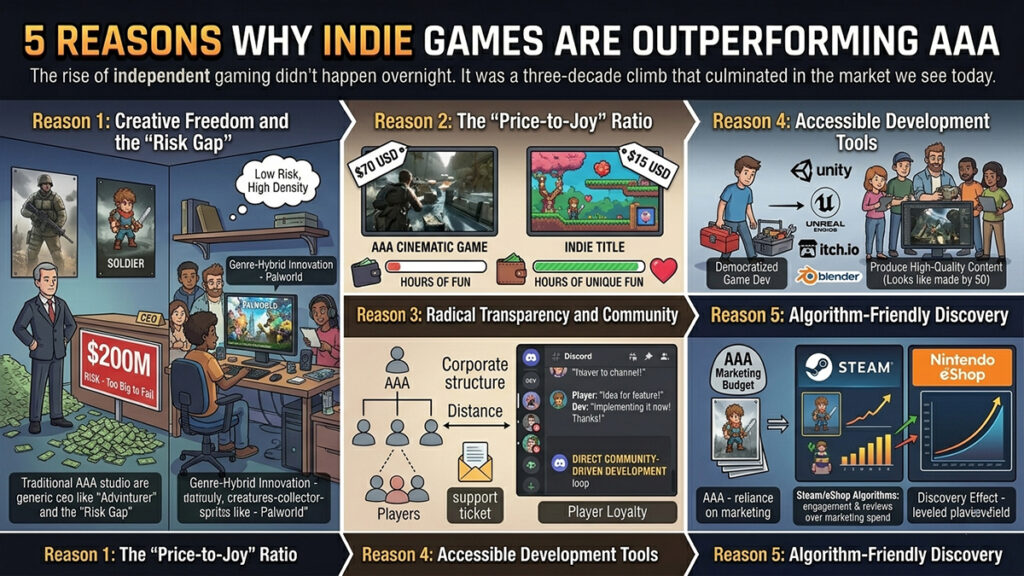
Creative Freedom and the “Risk Gap”
Major publishers are often “too big to fail.” They rely on established franchises because a $200 million failure could bankrupt them. Indie developers, however, thrive on innovation density. They experiment with genre-hybrids (like the “Survival-Creature-Collector” of Palworld) that major studios consider too risky.
The “Price-to-Joy” Ratio
With AAA titles pushing $70–$80 USD, players have become highly price-sensitive. Indie games typically range from $10–$30 USD. Gamers increasingly find that a $15 indie title provides more hours of unique fun than a $70 cinematic game they finish in one weekend.
Radical Transparency and Community
Indie devs interact directly with their players via Discord and Early Access. This creates a “Community-Driven Development” loop. When players feel like their feedback actually shapes the game, they become lifelong brand ambassadors—a level of loyalty billion-dollar corporations struggle to build.
Accessible Development Tools
Modern engines and asset marketplaces have “democratized” game dev. A team of five can now produce a game that looks and feels like it was made by fifty. This has flooded the market with high-quality, diverse content that caters to every niche imaginable.
Algorithm-Friendly Discovery
Digital storefronts like Steam and the Nintendo eShop use algorithms that favor engagement and reviews over marketing spend. If a small indie game starts trending, the algorithm amplifies it to millions. This “Discovery Effect” has leveled the playing field for studios with $0 marketing budgets.
While Steam is the commercial giant, platforms like itch.io act as the industry’s R&D lab, allowing developers to share experimental prototypes directly with fans. This grassroots accessibility is why indie games are often years ahead of AAA studios in terms of new genre-blending ideas
Innovation vs. Stability
AAA studios face “High Opportunity Costs” and “Risk Aversion” due to ballooning budgets, while indies leverage “Low Overheads” and “Agile Development” to iterate on niche mechanics.
Imagine the gaming industry is a race across a crowded harbor.
- AAA Studios are massive Cruise Ships. They are beautiful, expensive, and have 1,000-person crews. But they take miles to turn. If a new trend (like a “Co-op Extraction Horror” storm) appears, the Cruise Ship can’t just whip around—it has to check with the board of directors first. If it crashes, it’s a billion-dollar disaster. So, they stay in the “Safe Lanes” (sequels and remakes).
- Indie Studios are Speedboats. They don’t have a buffet or a movie theater on board, but they can turn on a dime. When they see a cool new island (a weird new genre), they just floor it. If they hit a rock, it hurts, but they can just jump into a new boat and try again.
The 2026 Bottom Line: In a world where player tastes change every week, being able to turn fast is now more valuable than being big.
Case Studies: The “Indie Giants” of 2025–2026
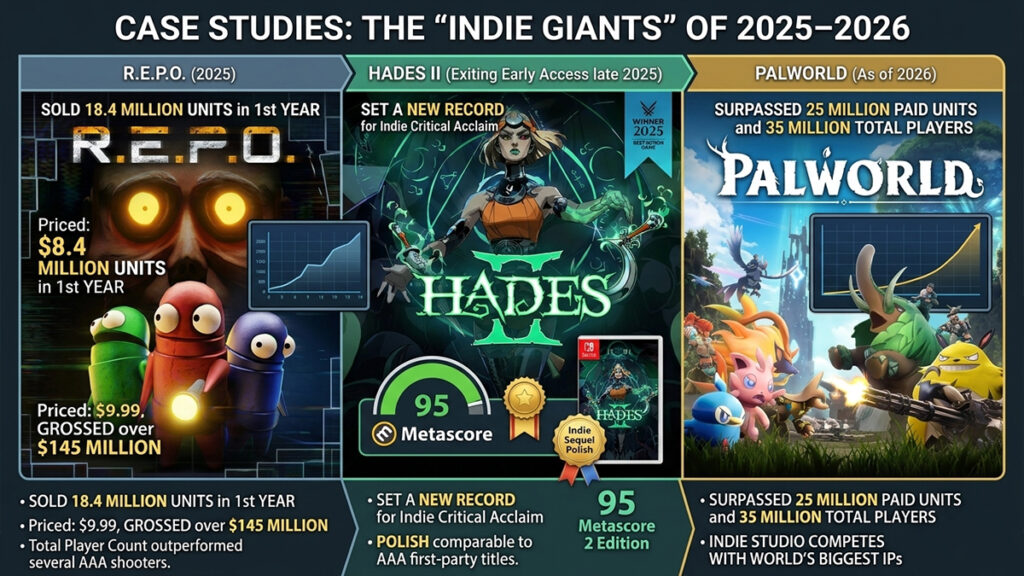
R.E.P.O. (2025): This co-op horror title sold 18.4 million units in its first year. Priced at just $9.99, it grossed over $145 million, outperforming several “blockbuster” shooters in total player count.
Hades II: After exiting Early Access in late 2025, it set a new record for indie critical acclaim, holding a 95 Metascore and proving that indie “sequels” can be just as polished as AAA first-party titles.
Palworld: As of 2026, this title has surpassed 25 million paid units and 35 million total players, proving that an indie studio can compete with the biggest IPs in the world (like Pokémon).
Indie vs. AAA: A New Industry Hierarchy
The industry is no longer a pyramid with AAA at the top. Instead, it has bifurcated into two distinct experiences:
| Feature | AAA Titles (The Specacle) | Indie Titles (The Soul) |
|---|---|---|
| Focus | Cinematic visuals & franchises | Unique mechanics & innovation |
| Pricing | Premium ($70+) | Accessible ($10–$30) |
| Strategy | High-budget, Low-risk | Low-budget, High-risk |
| Monetization | Often Live-Service / Microtransactions | Mostly Premium / Meaningful DLC |
Final Outlook: Is the Indie Boom Permanent?
Indie games are becoming more popular due to structural industry changes rather than short-term hype. Accessible development tools, direct distribution, community engagement, affordable pricing, and creative experimentation have positioned indie titles as a central pillar of modern gaming. What began as a niche movement has matured into a major economic and cultural force within the industry. For players, this means more variety, innovation, and value. For developers, it means lower barriers and greater opportunity. For the industry, it signals a lasting transformation.
Indie Games and the Rise of Independent Studios in 2026: FAQ ❓
Not exactly. AAA games still dominate “interactive cinema” and high-end graphical benchmarks. However, indie games are replacing AAA as the source of new trends and the primary driver of digital platform revenue.
They offer better value, more variety, and a closer relationship with the developers. Players are also flocking to indies to avoid the aggressive monetization (loot boxes, battle passes) often found in AAA live-service titles.
A “Triple-I” (III) game is an independent title that has the production values, team size, or budget of a mid-tier (AA) game but maintains its independent status and creative control.
Gamemonkey Verdict
“Indie” is no longer a genre
In 2026, “Indie” is no longer a genre, it’s a gold standard. As AAA studios retreat into safe sequels and $70 price tags, small teams are the ones actually taking risks and winning. If you want the most value and the freshest mechanics, your next favorite game is likely hiding in an Indie Spotlight.
✅ The Win: Innovative mechanics (like R.E.P.O.‘s physics) and a better “Price-to-Joy” ratio.
❌ The Catch: The market is flooded; finding the “gems” requires trusted curation.