The Complete Guide to Hall Effect Controllers: How They Work and Why Gamers Love Them
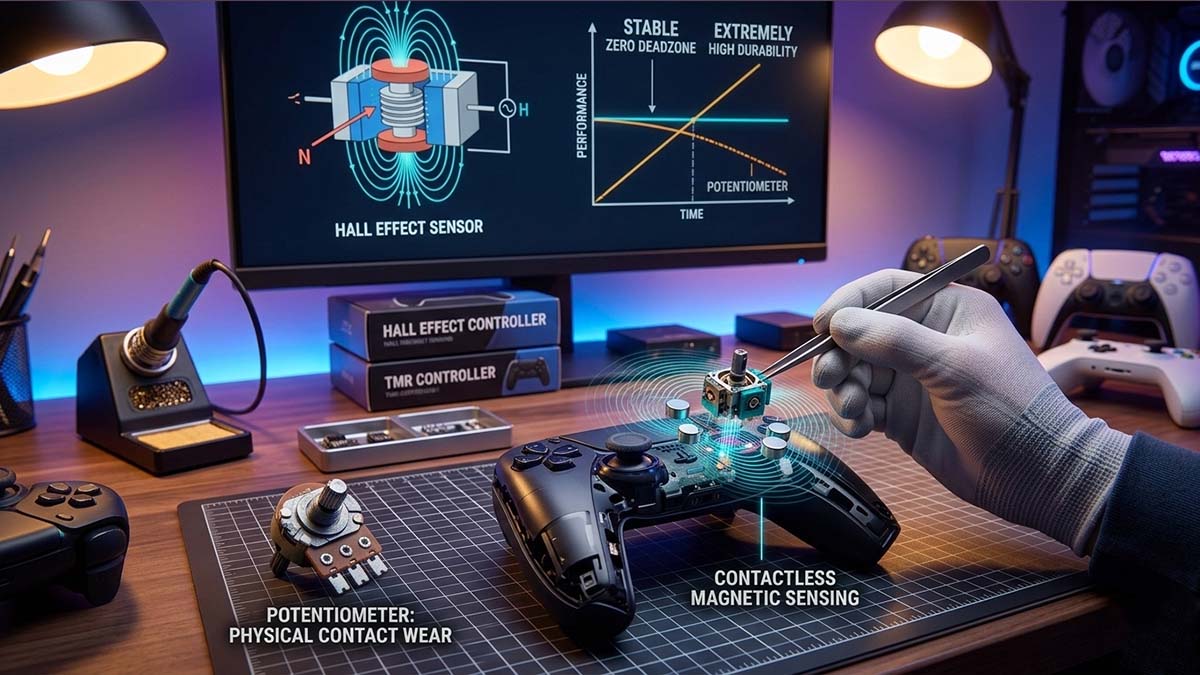
Gaming controllers have evolved far beyond simple joysticks and buttons. Whether you’re hitting the apex in a racing sim, executing a precise landing in a flight simulator, or competing in a high-stakes fighting game, input accuracy and durability matter more than ever.
Hall Effect controllers have gained popularity because they solve one of gaming’s longest-running hardware problems: stick drift. By using contactless magnetic sensors, they offer consistent precision, long-term reliability, and far greater longevity than traditional designs.
Is this for you?
If you’re tired of replacing controllers every six months, you need to know about Hall Effect technology. By using magnets instead of physical friction, these sensors virtually eliminate “stick drift” while offering precision that traditional controllers can’t match.
What Is a Hall Effect Controller?
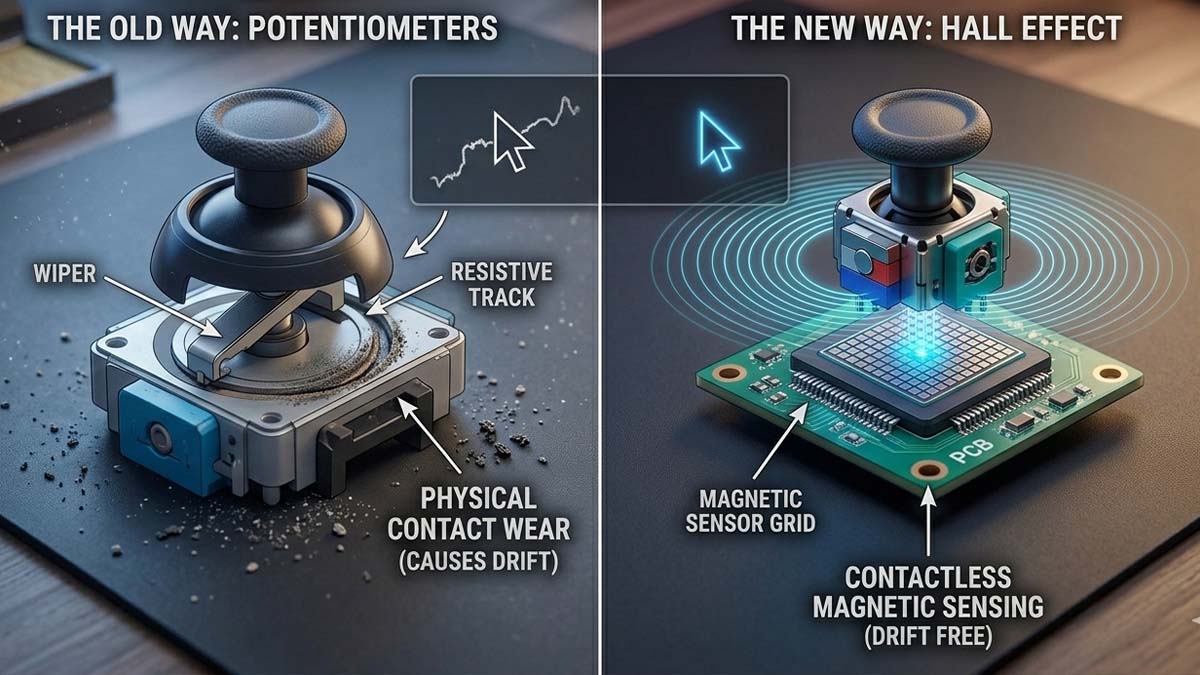
A Hall Effect controller is an input device that uses magnets and magnetic field sensors to detect movement without physical contact between the sensing components.
The Old Way (Potentiometers): Traditional controllers (like standard PS5 or Xbox pads) use a small “wiper” that slides across a resistive track. Think of it like a tire on a road—eventually, the tread wears down, causing jittery signals and the dreaded stick drift.
The New Way (Hall Effect): As the stick moves, a sensor measures the change in the magnetic field. Because nothing touches, there is no friction, no wear, and no degradation over time.
Key Differences at a Glance
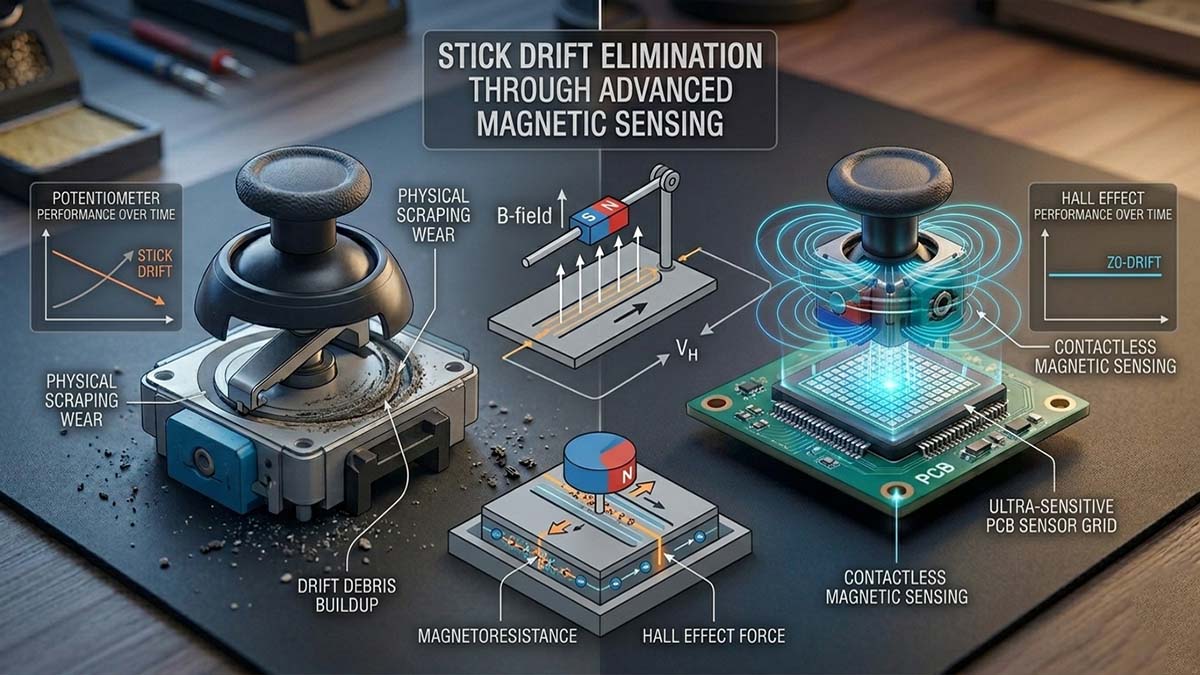
- Potentiometer controllers: Use physical contact; prone to wear and stick drift
- Hall Effect controllers: Use magnets and sensors; no contact means dramatically reduced wear and drift
Comparison: Hall Effect vs Potentiometer Controllers
| Feature | Hall Effect Controller | Potentiometer Controller |
|---|---|---|
| Sensing Method | Contactless magnetic sensor | Physical resistive contact |
| Durability | Very high (millions of cycles) | Moderate (wears with use) |
| Precision | High and consistent over time | Degrades over time |
| Stick Drift | Extremely rare | Common |
| Response | Smooth and linear | Can become jittery |
| Cost | Mid to high | Low to moderate |
| Best For | Competitive / long-term use | Casual / budget-focused |
How Do Hall Effect Controllers Work?
Hall Effect technology is based on a principle discovered by physicist Edwin Hall in 1879.
- The PhysicsWhen an electric current flows through a conductor and a magnetic field is applied perpendicular to it, a small voltage difference—called the Hall voltage—is produced.
- The ApplicationIn a controller, a small magnet is attached to the moving part of a joystick or trigger. As the stick moves, the magnet’s position relative to a stationary sensor changes.
- The ResultThe sensor detects these magnetic field changes and converts them into highly precise digital position data, allowing the system to track movement smoothly and accurately.
Because no parts touch during sensing, accuracy remains stable even after years of use.
The Next Evolution: What is TMR?
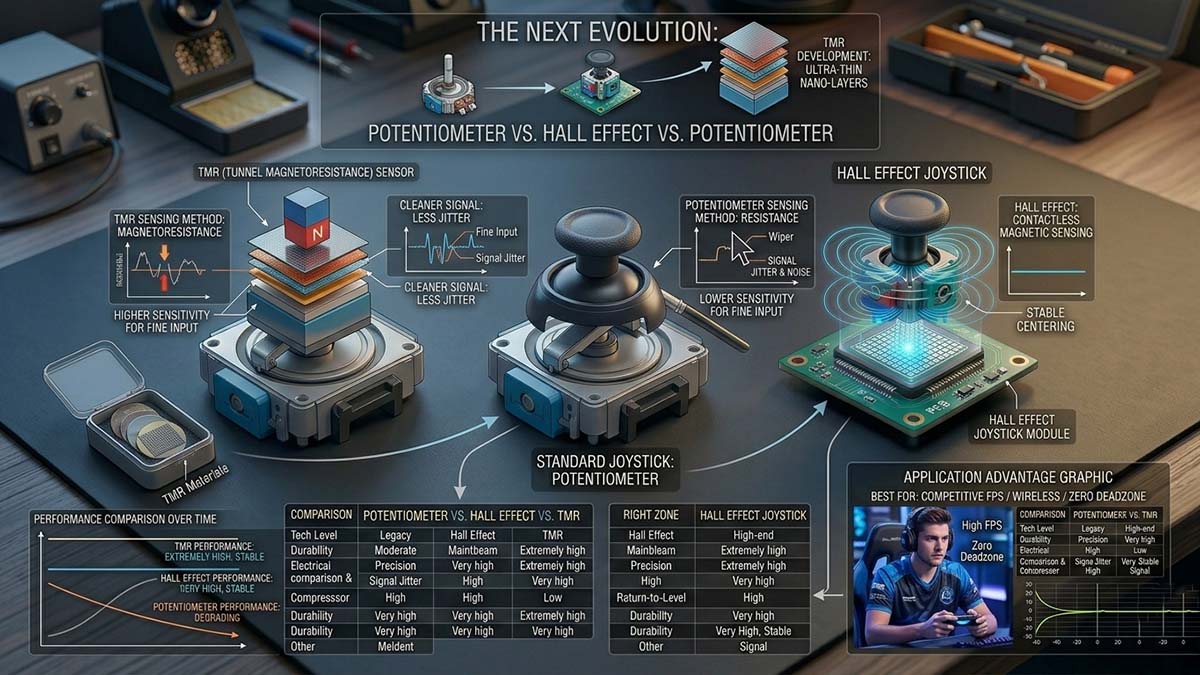
As Hall Effect technology becomes mainstream, some high-end controllers have begun using TMR (Tunnel Magnetoresistance) sensors.
While Hall Effect sensors measure changes in voltage caused by a magnetic field, TMR sensors measure changes in electrical resistance within ultra-thin material layers influenced by magnetism. In practical terms, this allows for higher sensitivity and efficiency.
Why TMR Is Gaining Attention
- Lower power consumption: TMR sensors are more energy-efficient, which can slightly improve battery life in wireless controllers (results vary by design).
- Higher sensitivity: TMR sensors can detect very small movements more reliably, which may benefit high-level competitive FPS players.
- Cleaner signal: TMR sensors often require less software filtering, which can reduce jitter and improve responsiveness when properly implemented.
That said, real-world performance still depends heavily on controller firmware, processor speed, and overall design.
Comparison: Potentiometer vs Hall Effect vs TMR
| Feature | Potentiometer | Hall Effect | TMR |
|---|---|---|---|
| Tech Level | Legacy | Modern mainstream | High-end |
| Sensing Method | Physical contact | Magnetic field | Magnetoresistance |
| Durability | Moderate | Very high | Extremely high |
| Precision | High (initially) | Very high (consistent) | Very high (especially fine input) |
| Power Draw | Low | Moderate | Lowest |
| Best For | Casual / budget | Most gamers | Competitive FPS / wireless |
The Cons: Is TMR Always Better?
TMR technology isn’t automatically the best choice for everyone.
- Higher cost: TMR controllers typically cost more than standard Hall Effect models.
- Implementation matters: A high-quality sensor paired with a slow processor or poor firmware won’t deliver meaningful gains.
- Limited benefits for casual play: In RPGs, platformers, or casual games, most players won’t notice a meaningful difference between Hall Effect and TMR.
- Availability: TMR is currently limited to higher-end third-party controllers.
Why Gamers Are Making the Switch

Stick drift occurs when potentiometer tracks wear down or become contaminated. Because Hall Effect sensors do not rely on physical contact, electrical wear-related drift is effectively eliminated.
- Superior Precision and Dead Zone Control
Hall Effect sensors allow for more stable and accurate input, enabling smaller or even zero dead zones in many games—particularly valuable in FPS, racing, and flight simulations. - Longevity
Typical potentiometers are rated for around 1–2 million cycles. Hall Effect sensors often last 10–20 million cycles or more, significantly extending controller lifespan.
Types of Hall Effect Peripherals
Hall Effect technology is used across a range of gaming hardware:
- Joysticks & flight sticks: Ideal for fine control in flight simulators
- Racing wheels & pedals: Provide smooth, linear throttle and brake input
- Analog triggers: Increasingly common in modern gamepads for precise acceleration and braking
Buyer’s Guide: What to Look For
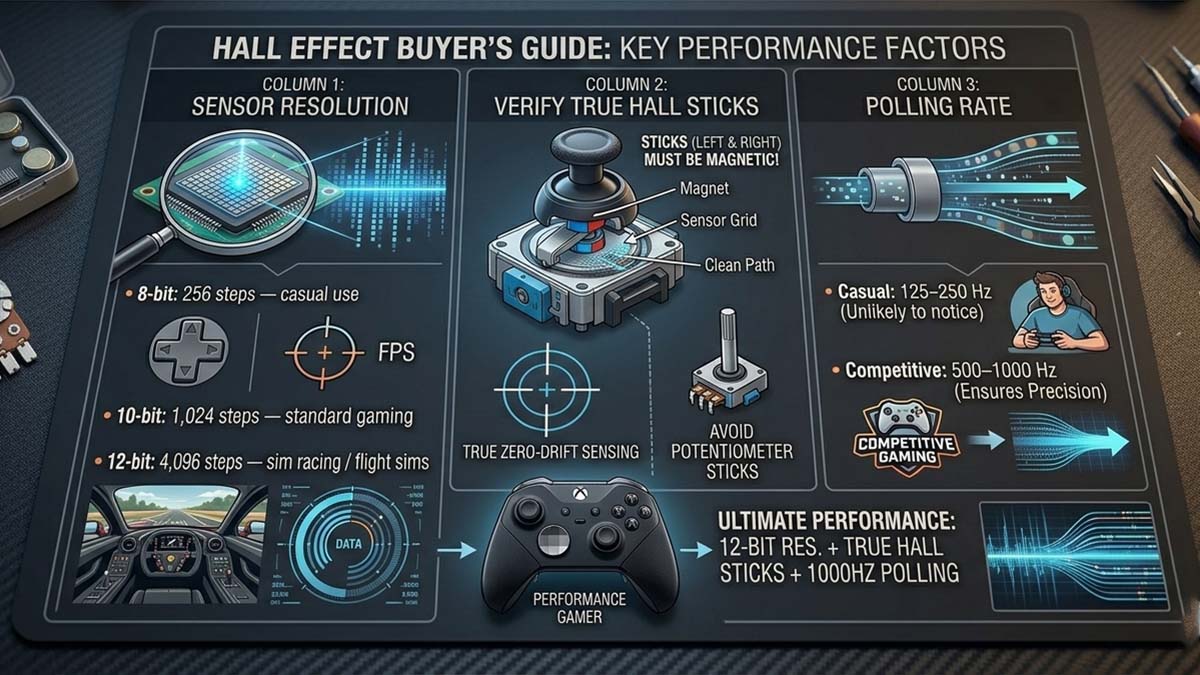
When shopping for a Hall Effect controller, focus on these three factors:
1. Sensor Resolution
Higher resolution means finer input control:
- 8-bit: 256 steps — casual use
- 10-bit: 1,024 steps — standard gaming
- 12-bit: 4,096 steps — sim racing / flight sims
2. Verify True Hall Effect Sticks
Some controllers only use Hall Effect sensors for triggers while retaining potentiometer sticks. Always confirm that the analog sticks themselves are magnetic.
3. Polling Rate
For competitive gaming, higher polling rates (500–1000Hz) help ensure sensor precision isn’t limited by slow data transmission. Casual players are unlikely to notice a difference.
Maintenance and Care
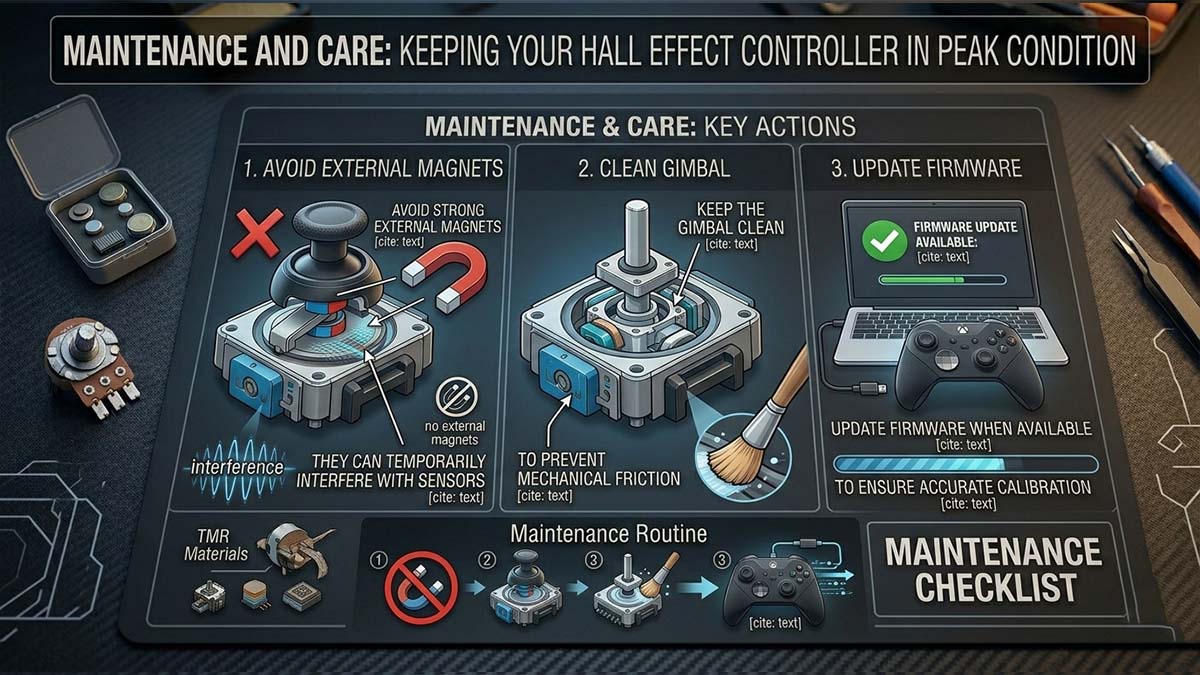
Hall Effect controllers are low-maintenance, but not indestructible:
- Avoid strong external magnets, which can temporarily interfere with sensors
- Keep the gimbal clean to prevent mechanical friction
- Update firmware when available to ensure accurate calibration
Frequently Asked Questions (FAQ)
Sony and Microsoft do not use Hall Effect sensors in standard controllers. Hall Effect options are primarily third-party or “Pro” models.
- Cost at scale: Potentiometers are far cheaper in mass production
- Licensing complexity: Some designs involve patents
- Accessory economics: Shorter controller lifespans drive repeat sales
If you play more than 10 hours a week, yes. The controller will likely outlast your console.
Final Verdict: Is It Worth It?
- Competitive and sim gamers: Strongly recommended. The durability and consistency are meaningful advantages.
- Casual gamers: Not essential, but worth considering if you frequently replace controllers due to drift. Over time, a Hall Effect controller can be more cost-effective.
Hall Effect vs. TMR vs. Potentiometer: Pros & Cons Comparison
Hall Effect
TMR Tech
Potentiometers
GameMonkey Verdict
A “Must-Have” Upgrade
Hall Effect isn’t just a trend; it’s the new hardware standard. If you are a competitive player or someone who hates the ‘planned obsolescence’ of standard controllers, the investment pays for itself in durability alone. Skip the potentiometers—your aim (and your wallet) will thank you.